The end of the "it's a work ute" FBT myth
 Di Crawford Errington

Ask a room of tradies whether their branded double cab attracts FBT and most will say no. It's a work vehicle. It's got the logo on it. But is it?
Except it was never quite that simple. And from 1 April 2027, if the new Bill passes as drafted, it won't matter at all.
What's happening
On 10 September 2026, the Government introduced the Taxation (Annual Rates for 2026–27, FBT Simplification, Foreign Investment Funds, and Remedial Measures) Bill. The biggest change for small business owners is a complete rethink of how FBT applies to motor vehicles under the Income Tax Act 2007.
Inland Revenue's own review found FBT wasn't working well and was poorly complied with. That won't surprise anyone who has tried to track which days a vehicle was "available for private use".
Goodbye day-counting
Right now, FBT on vehicles is worked out by counting the days a vehicle could be used privately. Logbooks, three-month test periods, exemptions for call-outs and business travel. It's complicated, and a lot of admin for something most people get wrong anyway.
The new approach is described as "close enough is good enough". You choose a category for each vehicle based on its expected private use, and that category sets the rate. You only revisit it if the use changes materially.
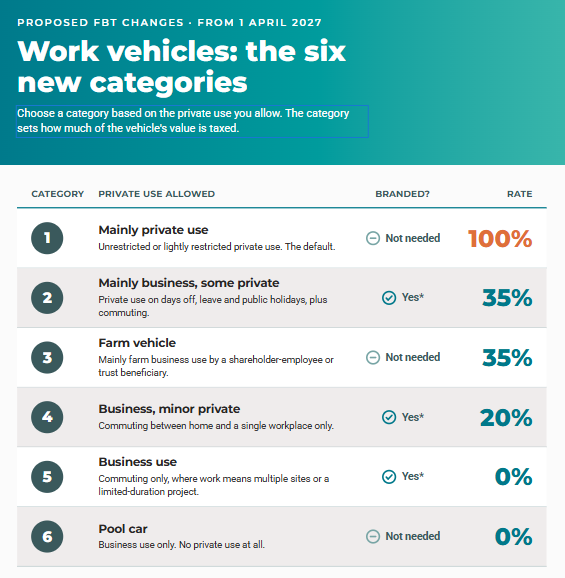
*Farming businesses that aren't widely held are exempt from branding, and other businesses can apply to Inland Revenue for an exemption.
If you don't pick a category, you're in category 1 by default. That's full FBT.
Where businesses could get caught out
The work-related vehicle exemption, the emergency call exemption and the business travel exemption are all being removed. The new categories replace them.
That means your ute's shape and logo no longer decide the outcome. What matters is what you allow your team to do with it.
Branding also has to be permanent and prominent. If your team pulls off magnetic signs for the weekend, that vehicle is likely to land in category 1. The branding rules only apply to vehicles bought or leased after the Bill was introduced, so existing unbranded vehicles won't need signwriting to qualify.
A scenario we see more often than you'd think
Picture a small Northland building company. Four staff, four branded utes. The owner, let's call him Mike, bought magnetic signs for each one because they were cheap and easy to swap when a ute was sold.
The team takes the utes home every night and uses them on weekends. Mike sees that as a perk of the job. It's never been written into anyone's employment agreement, and no FBT has ever been filed. After all, they're work utes.
Here's the thing. Under the current rules, those utes were never exempt. Magnetic signs aren't permanent, and unrestricted weekend use is private use. Mike has been exposed to FBT all along without knowing it.
Under the proposed new rules, nothing improves on its own. With removable signs and free weekend use, those utes would fall into category 1. Full FBT.
But Mike has options. If he signwrites the utes and limits private use to travel between home and the job sites, they could sit in category 5 at 0%, because his team moves between multiple sites. If he wants to keep weekend use as a perk, category 2 at 35% could apply instead, and that perk becomes a deliberate, costed part of his team's package rather than an accidental tax bill.
Same utes. Same team. Very different outcome, depending on the decisions he makes and writes down.
Some good news too
- Occasional one-off use, like borrowing the van to move house, is ignored when choosing a category.
- There are new, lower valuation rates for hybrids and EVs.
- The weight limit rises from 3,500 kg to 6,000 kg, so heavier vehicles (including many EVs) sit outside the motor vehicle rules altogether.
- The rates will be reviewed every four years using AA running cost data and MBIE fuel data.
What to do now
This is still a Bill, and select committee may change the details. But there's plenty you can do before April 2027:
- List every vehicle your business provides, and who drives it.
- Check what you've agreed in employment agreements about private use.
- Look at whether your branding is permanent.
- Think about any vehicles you're planning to buy or lease. Branding rules already apply to those.
- Talk to your adviser about which category each vehicle is likely to fall into.
FBT sits right alongside payroll. It's part of how you reward your team, and getting it right protects both you and them.
You don't know what you don't know. If you'd like a second pair of eyes on your vehicle setup before the new rules kick in, we're here to help.
#getitright #youdontknowwhatyoudontknow
Categories: : Tax
Ask a room of tradies whether their branded double cab attracts FBT and most will say no. It's a work vehicle. It's got the logo on it. ...

The most significant change to payroll in over 20 years is here — a complete replacement of the Holidays Act.

We are half way through 2026 - What Do Payroll Professionals Need to Know

I’ve learned that most issues don’t start with bad intent. They start with assumptions.

KiwiSaver, Minimum Wage, ACC, Gateway test & the new Employers Leave Act, what you need to action before and after 1 April 26.
This is one of the most significant changes to New Zealand employment legislation in over two decades — and you have less than a week to i ...
